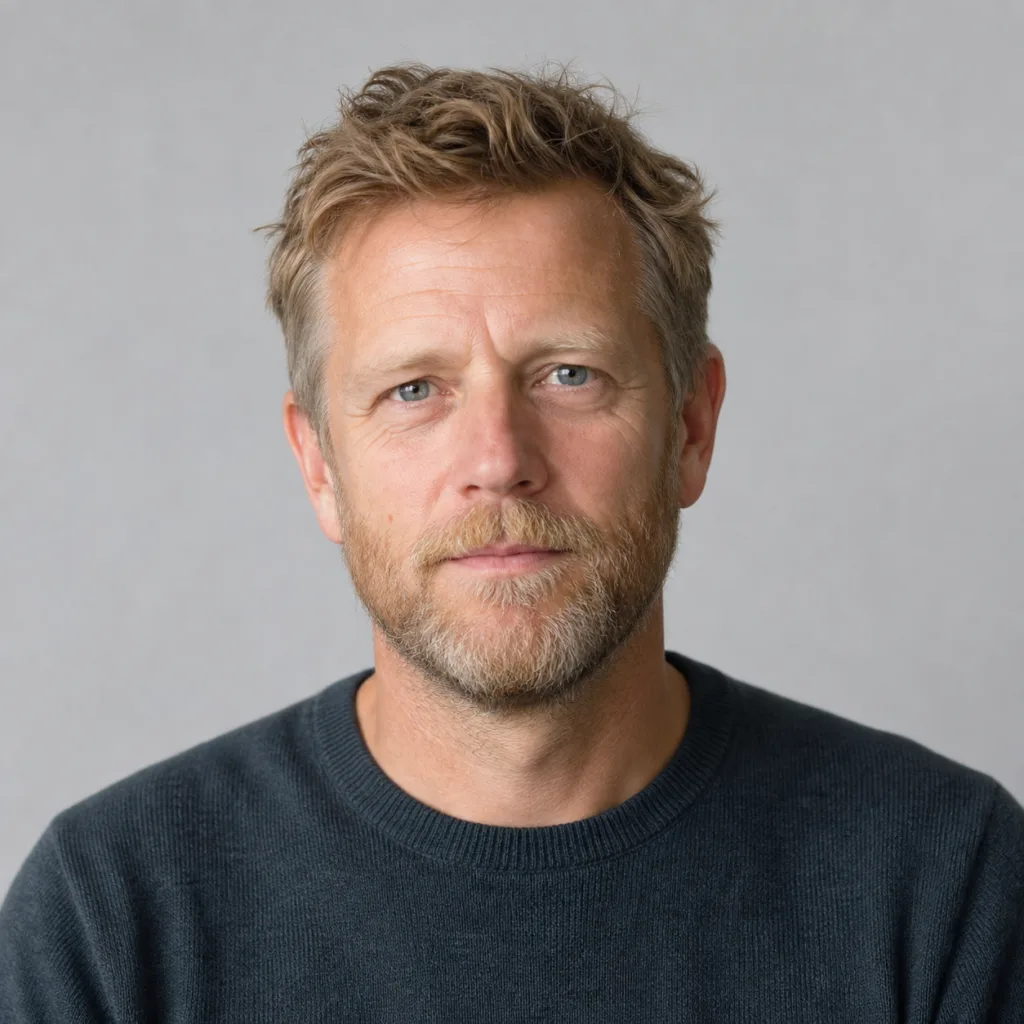
Eirik reads sea ice as a moving material, not a white surface on a map. He connects local thickness, deformation, drift, and melt observations with the wider satellite record.
He leads the fictional sea ice programme with a strong preference for repeatable methods and modest claims. A pressure ridge, melt pond, or open lead can reveal an important process without representing an entire region. Eirik expects each field note to name the scale of the observation and the conditions that shaped it.
Education
Eirik earned a PhD in physical oceanography at UiT The Arctic University of Norway and an MSc in marine technology at NTNU. His training covered ocean circulation, ice mechanics, remote sensing, instrument systems, and the practical limits of operating equipment in cold, moving environments.
Experience
He is a veteran of eighteen ship campaigns and ice camps in his fictional professional history. Those seasons taught him that safe logistics and sound science are inseparable. He has planned transects, compared in situ measurements with radar products, and learned when wind, visibility, or ice movement should end a measurement day early.
Current focus
His current focus is the changing age and structure of Arctic sea ice. He studies how thinner, younger cover responds to wind and waves, and how deformation complicates thickness estimates. He connects site observations to regional records without erasing local variability or uncertainty.
Beyond work
Eirik repairs field stoves because he dislikes equipment that becomes disposable for want of a small part. He also plays fiddle, usually at a volume considerate of thin cabin walls. Both activities depend on listening closely before making the next adjustment.