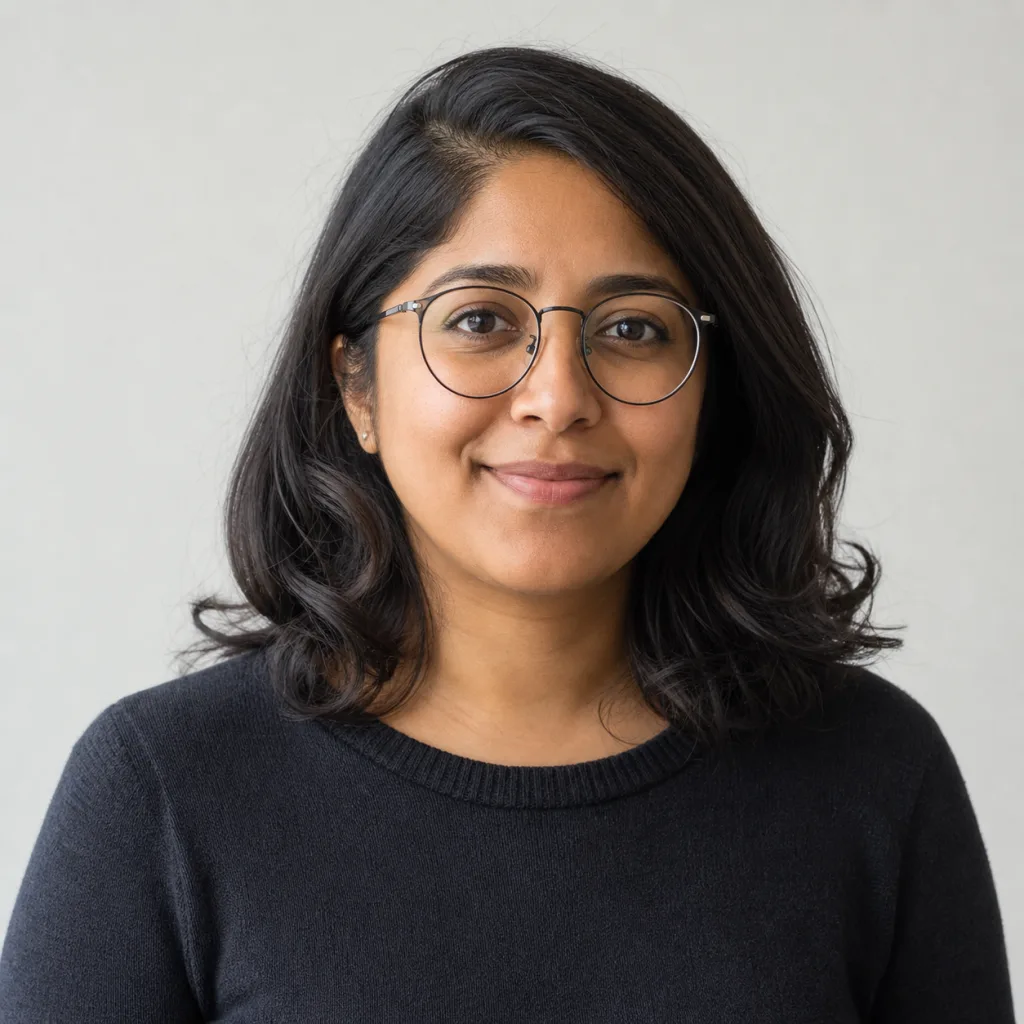
Noor listens for relationships among marine-mammal calls, sea state, ice, and vessel noise. She treats every recording as both sound and a bundle of essential context.
Her work asks what an instrument could hear, what else was present, and what remains ambiguous. Noor is cautious about turning a compelling spectrogram into a population claim. She combines acoustic detections with deployment depth, weather, vessel activity, and observation effort so absence is not confused with silence.
Education
Noor completed a PhD through the MIT-WHOI Joint Program and an MEng in acoustical engineering at the University of Southampton. Her training spans signal processing, underwater propagation, marine ecology, electronics, and statistical methods for detecting patterns in noisy and unevenly sampled records.
Experience
She has studied marine-mammal calls and vessel noise in her fictional professional background. That experience includes hydrophone deployment, calibration checks, annotation protocols, and conversations with mariners about operations. She has learned that a clean recording can still carry uncertain attribution and that sharing locations may require care.
Current focus
Her current focus is interpreting acoustic change without overstating cause. She examines quieter operational choices, seasonal shipping patterns, ice conditions, and the confidence of call classification. She also works on public listening tools that reveal the surrounding noise and metadata instead of presenting isolated animal sounds as spectacle.
Beyond work
Noor records dawn choruses far from roads and repairs old radios whose faults can be traced with patience. She likes devices that make hidden signals audible while leaving room for uncertainty. Her desk holds several labeled cables and exactly one mug that no one else is permitted to borrow.