By Elín Bjarnadóttir, fictional Still North staff member. Published .
Not peer reviewed. Fictional demonstration publication. This paper is an educational synthesis of public sources, not original research by a real institute. Illustrative examples are not measured findings. The cover is a generated illustration. SN-2026-057 is a local archive identifier, not a DOI.
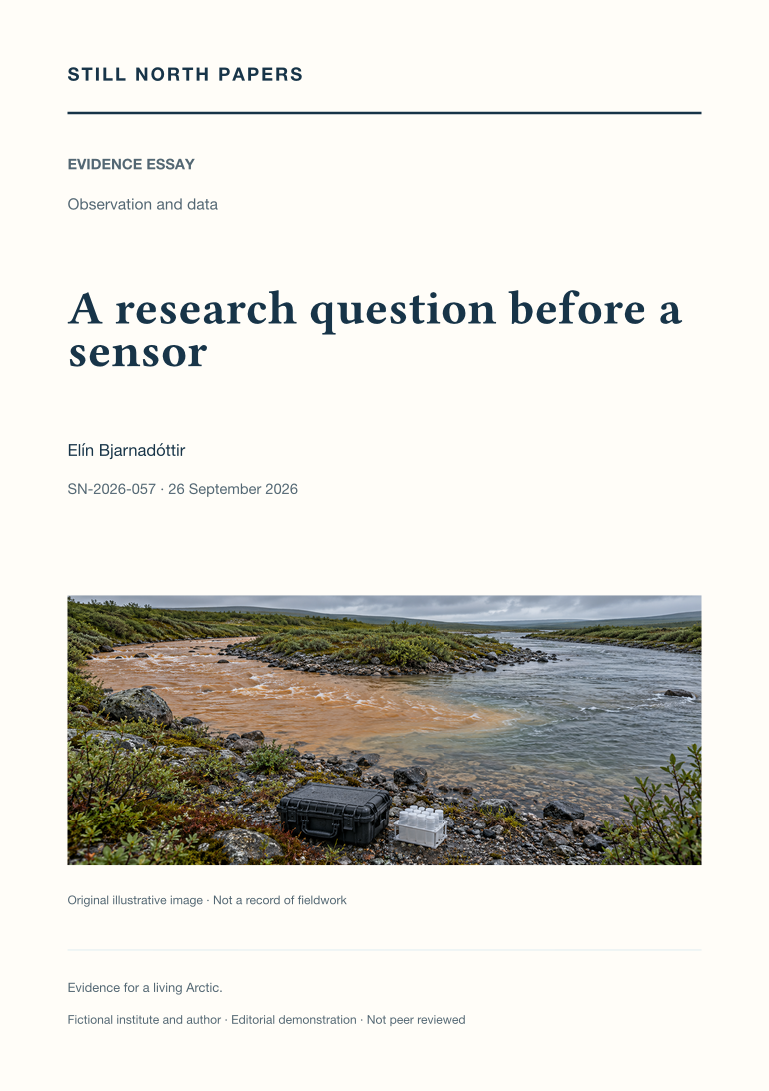
Abstract
Choosing a sensor before defining the research question can produce precise data that do not answer the original concern. This essay works backwards from a hypothetical river-colour problem to distinguish community concern, a researchable comparison, and the decision a limited study might inform. It examines competing explanations, representative locations, event timing, existing records, and plans for unsafe access or missing samples. The National Inuit Strategy on Research supplies governance context, and NOAA's network assessment illustrates why more observations at an unsuitable location do not repair every gap. Equipment selection follows the required quantity, discrimination, and coverage, with maintenance and stewardship included. Rehearsing a possible result using explicitly invented values tests whether the proposed observations could distinguish explanations without predetermining the finding.
- Paper type
- Evidence essay
- Topic
- Observation and data
- Keywords
- research design; sampling strategy; competing explanations; measurement selection; river water
- Format
- PDF, 2 pages; 722 words
Adaptation note
This paper adapts an existing Still North field-journal article. The original is retained unchanged. Read the source journal article; download its paper edition (PDF).
Sources and context
The PDF discusses these public sources and its limitations. A citation is not an endorsement of this demonstration archive.