By Eirik Solheim, fictional Still North staff member. Published .
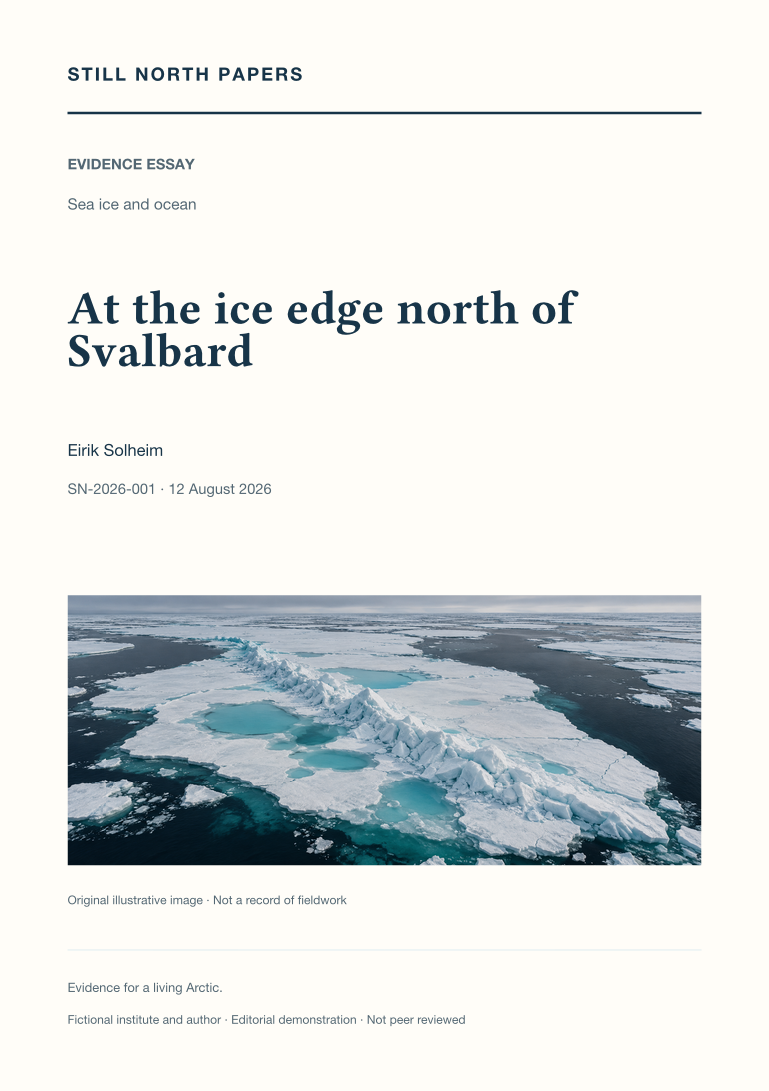
Not peer reviewed. Fictional demonstration publication. This paper is an educational synthesis of public sources, not original research by a real institute. Illustrative examples are not measured findings. The cover is a generated illustration. SN-2026-001 is a local archive identifier, not a DOI.
Abstract
Using an explicitly illustrative scene north of Svalbard, this essay examines how an ice-edge observation becomes evidence without becoming a claim about the whole Arctic. Pressure ridges expose the sampling problem of unusually thick features, while melt ponds show why date, drainage, weather, and surface geometry matter to comparisons. The published sea-ice record supplies regional context for a younger ice cover, rather than results attributed to fictional fieldwork. Distant polar-bear and kittiwake observations introduce wildlife protocols, observation effort, and the limits of inferring habitat or breeding outcomes from brief encounters. The account concludes that representative sampling, matched scales, safe stopping decisions, and a documented handover are more informative than an apparently complete photographic story.
- Paper type
- Evidence essay
- Topic
- Sea ice and ocean
- Keywords
- ice edge; pressure ridges; melt ponds; sampling scale; wildlife distance
- Format
- PDF, 2 pages; 700 words
Adaptation note
This paper adapts an existing Still North field-journal article. The original is retained unchanged. Read the source journal article; download its paper edition (PDF).
Sources and context
The PDF discusses these public sources and its limitations. A citation is not an endorsement of this demonstration archive.