By Ivalu Petersen, fictional Still North staff member. Published .
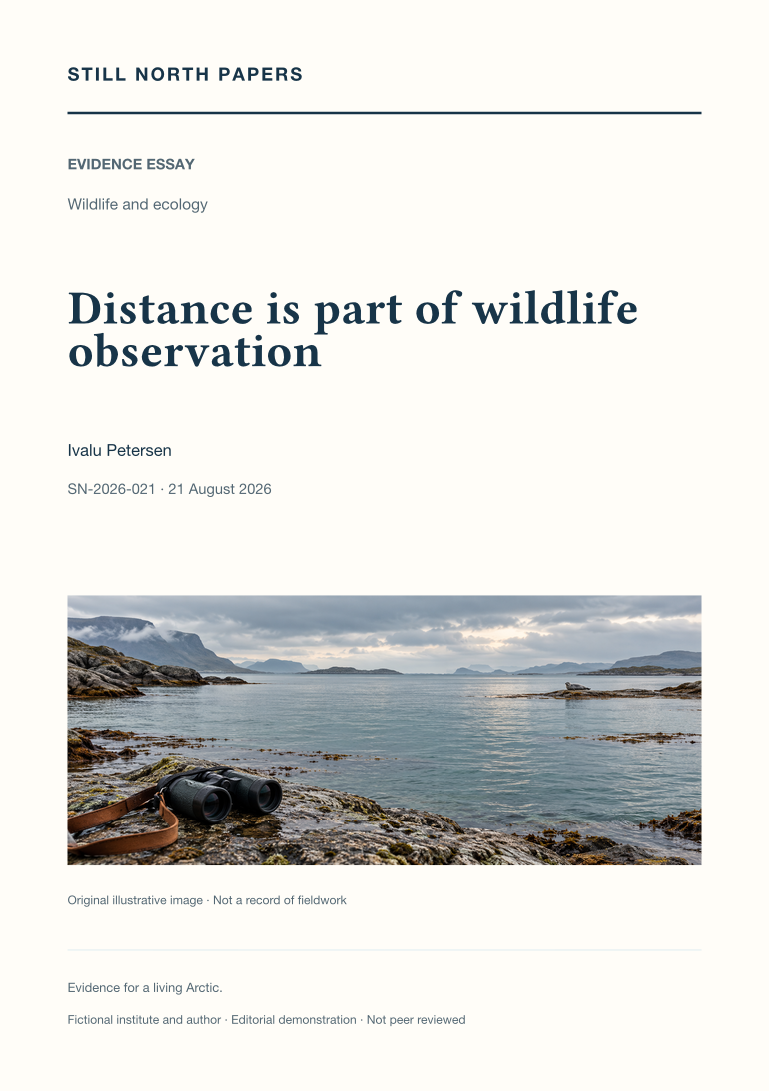
Not peer reviewed. Fictional demonstration publication. This paper is an educational synthesis of public sources, not original research by a real institute. Illustrative examples are not measured findings. The cover is a generated illustration. SN-2026-021 is a local archive identifier, not a DOI.
Abstract
Wildlife observation is assessed through the choices that precede a photograph, not the closeness or apparent calm of its subject. Using NOAA marine-life viewing guidance, the essay explains why an absent visible response does not prove no disturbance and why a minimum distance is not a target. A hypothetical comparison contrasts distant viewing with repeated pursuit that could produce a similarly framed image. Duration, crowding, access routes, young animals, vessel sound, and current local requirements all affect the encounter. Public viewing remains distinct from permitted research, and sensitive locations may require restricted sharing. The piece provides no universal distance or safety protocol. Its practical implication is to document a respectful method, accept leaving without an image, and never treat a generated scene as evidence of compliant fieldwork.
- Paper type
- Evidence essay
- Topic
- Wildlife and ecology
- Keywords
- wildlife viewing; disturbance; observation distance; research permits; sensitive locations
- Format
- PDF, 2 pages; 729 words
Adaptation note
This paper adapts an existing Still North field-journal article. The original is retained unchanged. Read the source journal article; download its paper edition (PDF).
Sources and context
The PDF discusses these public sources and its limitations. A citation is not an endorsement of this demonstration archive.