By Omar Haddad, fictional Still North staff member. Published .
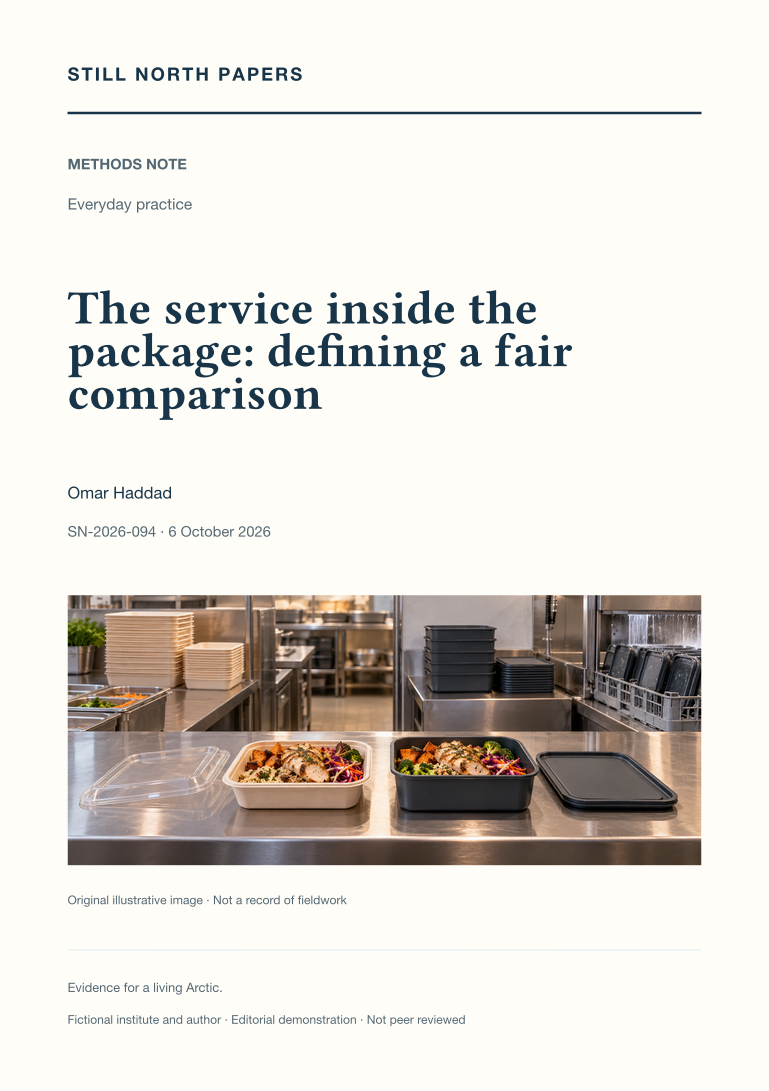
Not peer reviewed. Fictional demonstration publication. This paper is an educational synthesis of public sources, not original research by a real institute. Illustrative examples are not measured findings. The cover is a generated illustration. SN-2026-094 is a local archive identifier, not a DOI.
Abstract
Packaging comparisons become misleading when they count empty objects rather than equivalent deliveries. This methods note develops a functional-unit procedure for a small food service, drawing on the GHG Protocol Product Standard, the European Commission’s Environmental Footprint recommendation, and the Environment Agency’s original carrier-bag assessment. A hypothetical returnable-container case distinguishes completed meals, realised reuse, delayed returns, washing, replacement lids, collection journeys, and food loss. The analysis explains why consistent boundaries and evidence of displacement matter before environmental rankings are attempted. It also keeps accessibility and food safety outside any simplistic carbon score. No packaging footprints or savings are estimated. The proposed decision record identifies which operational observations and supplier information would be needed to support a defensible local comparison.
- Paper type
- Methods note
- Topic
- Everyday practice
- Keywords
- functional units; packaging; reuse; life-cycle boundaries
- Format
- PDF, 3 pages; 1425 words
Sources and context
The PDF discusses these public sources and its limitations. A citation is not an endorsement of this demonstration archive.