By Sofia Mendes, fictional Still North staff member. Published .
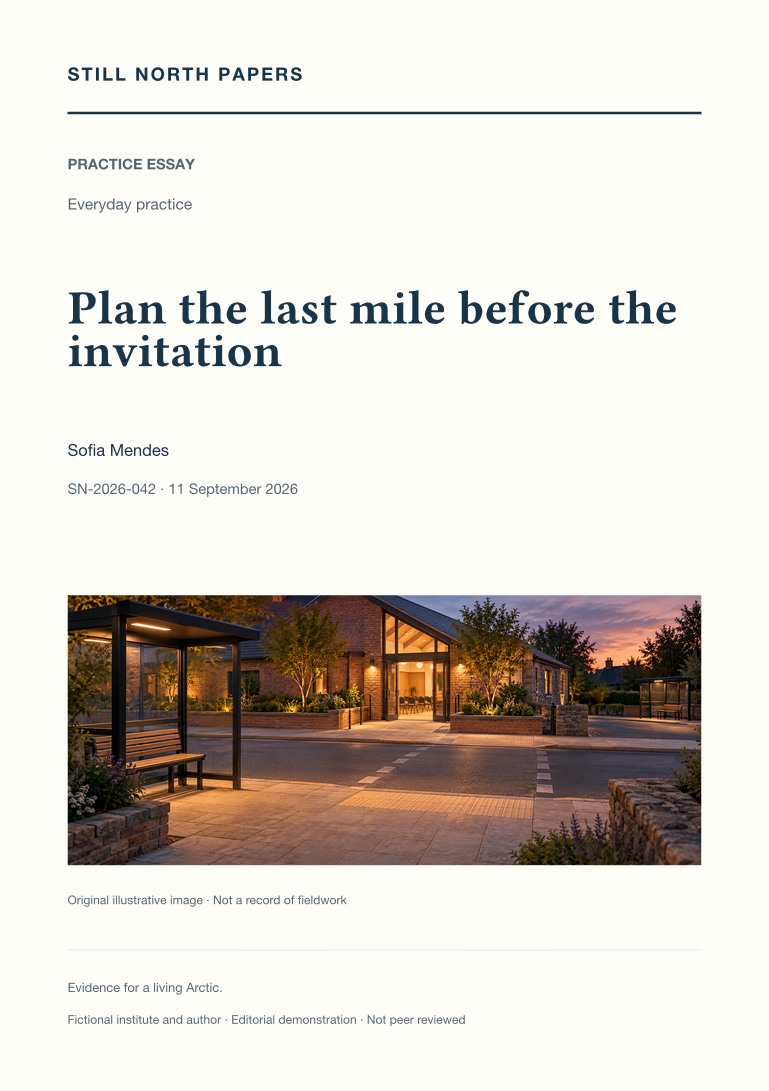
Not peer reviewed. Fictional demonstration publication. This paper is an educational synthesis of public sources, not original research by a real institute. Illustrative examples are not measured findings. The cover is a generated illustration. SN-2026-042 is a local archive identifier, not a DOI.
Abstract
An event's location and timetable shape who can attend and whether lower-impact travel is genuinely usable. This practice essay evaluates complete arrival and return chains rather than proximity to a station alone. It draws on event-planning guidance to connect access features, programme timing, communication support, and travel budgets. A hypothetical late finish shows why an earlier schedule, different venue, funded transport, or another participation format may matter more than a journey-planning link. Specific access information must identify both confirmed features and limitations, with arrangements for updates and private support requests. The discussion rejects guarantees about changing transport infrastructure and public judgements of attendees' travel modes. Its practical conclusion is to build access into venue selection, staffing, and funding before invitations fix the choices.
- Paper type
- Practice essay
- Topic
- Everyday practice
- Keywords
- event planning; accessible travel; last-mile access; public transport; participation
- Format
- PDF, 2 pages; 738 words
Adaptation note
This paper adapts an existing Still North field-journal article. The original is retained unchanged. Read the source journal article; download its paper edition (PDF).
Sources and context
The PDF discusses these public sources and its limitations. A citation is not an endorsement of this demonstration archive.