By Omar Haddad, fictional Still North staff member. Published .
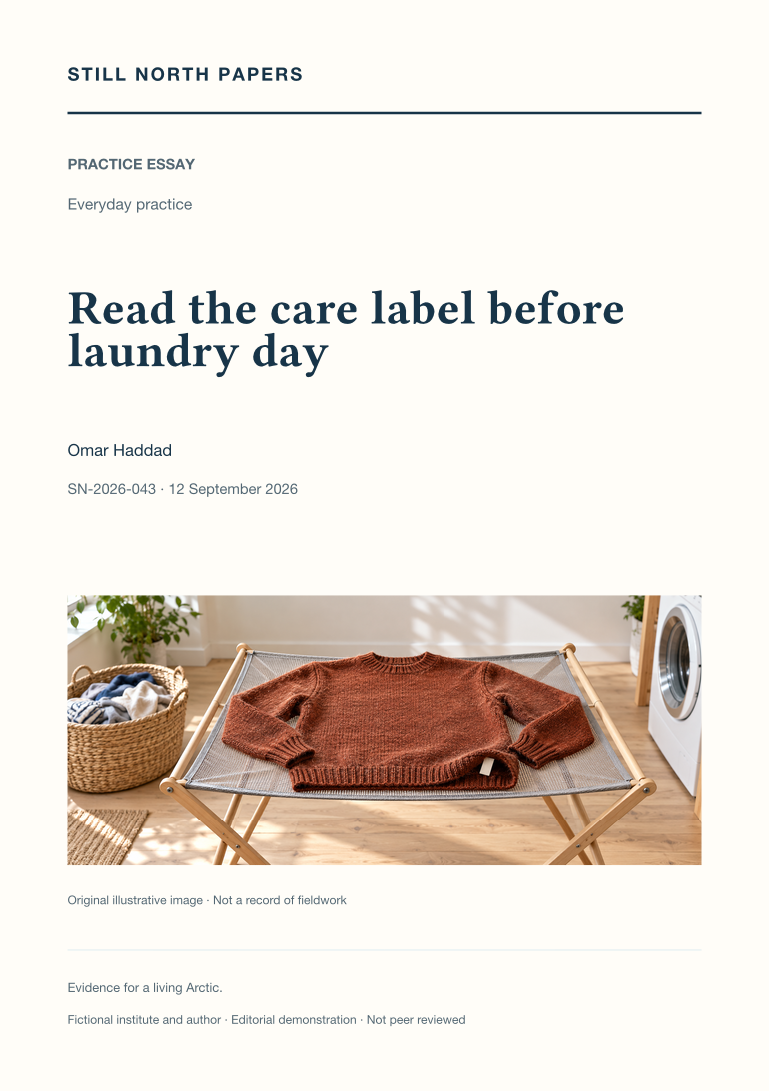
Not peer reviewed. Fictional demonstration publication. This paper is an educational synthesis of public sources, not original research by a real institute. Illustrative examples are not measured findings. The cover is a generated illustration. SN-2026-043 is a local archive identifier, not a DOI.
Abstract
Garment usefulness depends on care requirements as well as fabric condition. This practice essay uses GINETEX guidance to distinguish washing temperature, mechanical action, drying, and professional treatment, explaining why a fibre name or a cooler normal cycle cannot replace the full label. It matches cleaning to the item's use while retaining hygiene, workplace, and chemical-safety limits. Drying space, ventilation, mobility, shared machines, and household schedules affect what care is achievable; a rule suited to one home may be impossible in another. The discussion also treats cleaning demands as part of purchasing and uniform provision, rather than unpaid labour that can be assumed. Simple shared records can preserve instructions and prevent avoidable damage, without promising indefinite garment life or one universal laundry routine.
- Paper type
- Practice essay
- Topic
- Everyday practice
- Keywords
- garment care; care labels; laundry; drying constraints; clothing longevity
- Format
- PDF, 2 pages; 766 words
Adaptation note
This paper adapts an existing Still North field-journal article. The original is retained unchanged. Read the source journal article; download its paper edition (PDF).
Sources and context
The PDF discusses these public sources and its limitations. A citation is not an endorsement of this demonstration archive.