By Priyanka Das, fictional Still North staff member. Published .
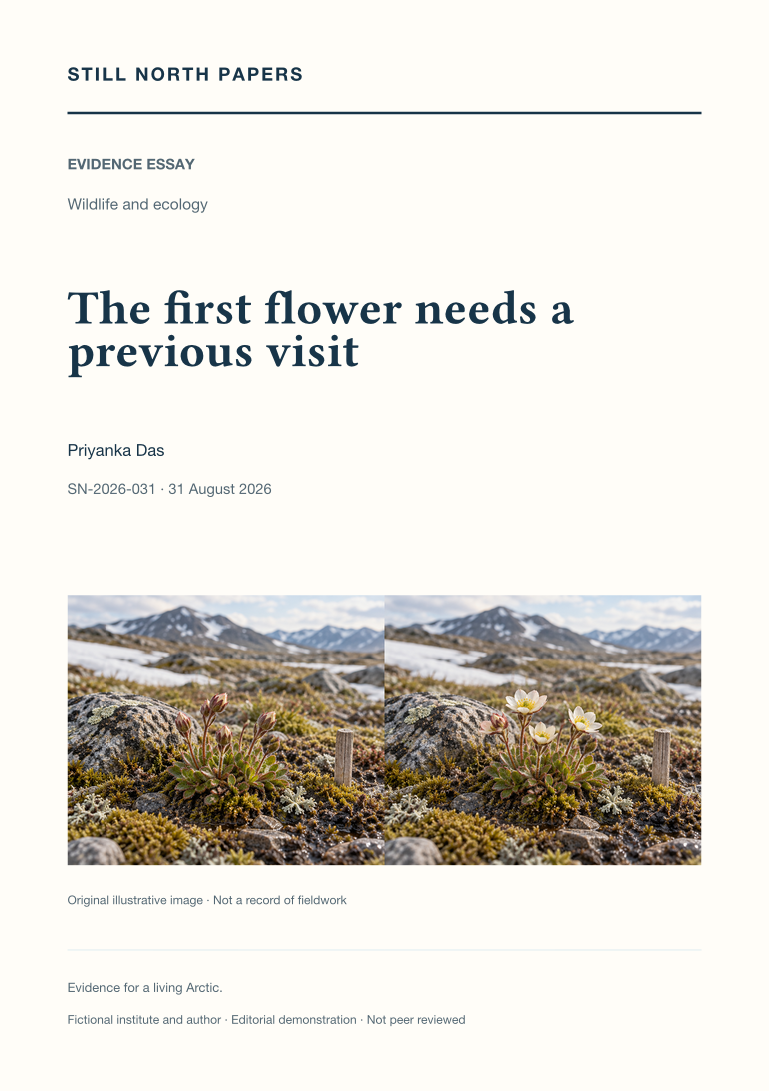
Not peer reviewed. Fictional demonstration publication. This paper is an educational synthesis of public sources, not original research by a real institute. Illustrative examples are not measured findings. The cover is a generated illustration. SN-2026-031 is a local archive identifier, not a DOI.
Abstract
A first flowering detection identifies a visit, not necessarily the day flowering began. This essay explains how repeated positive, negative, and uncertain observations bound onset, using an explicitly illustrative sequence rather than a field result. It distinguishes a consistently monitored plant or patch from an expanding search area, and separates first flowering, peak abundance, and duration. Snow conditions and observation frequency can affect apparent timing, so changes in detection require interpretation before they become claims of biological change. Drawing on USA National Phenology Network documentation, the discussion also shows why a proposed flower–pollinator mismatch needs adequate records of both organisms. Its practical conclusion is to preserve visit intervals, stage definitions, search effort, and missing coverage alongside the reported dates.
- Paper type
- Evidence essay
- Topic
- Wildlife and ecology
- Keywords
- phenology; flowering onset; observation intervals; negative observations; pollinators
- Format
- PDF, 2 pages; 743 words
Adaptation note
This paper adapts an existing Still North field-journal article. The original is retained unchanged. Read the source journal article; download its paper edition (PDF).
Sources and context
The PDF discusses these public sources and its limitations. A citation is not an endorsement of this demonstration archive.