By Elín Bjarnadóttir, fictional Still North staff member. Published .
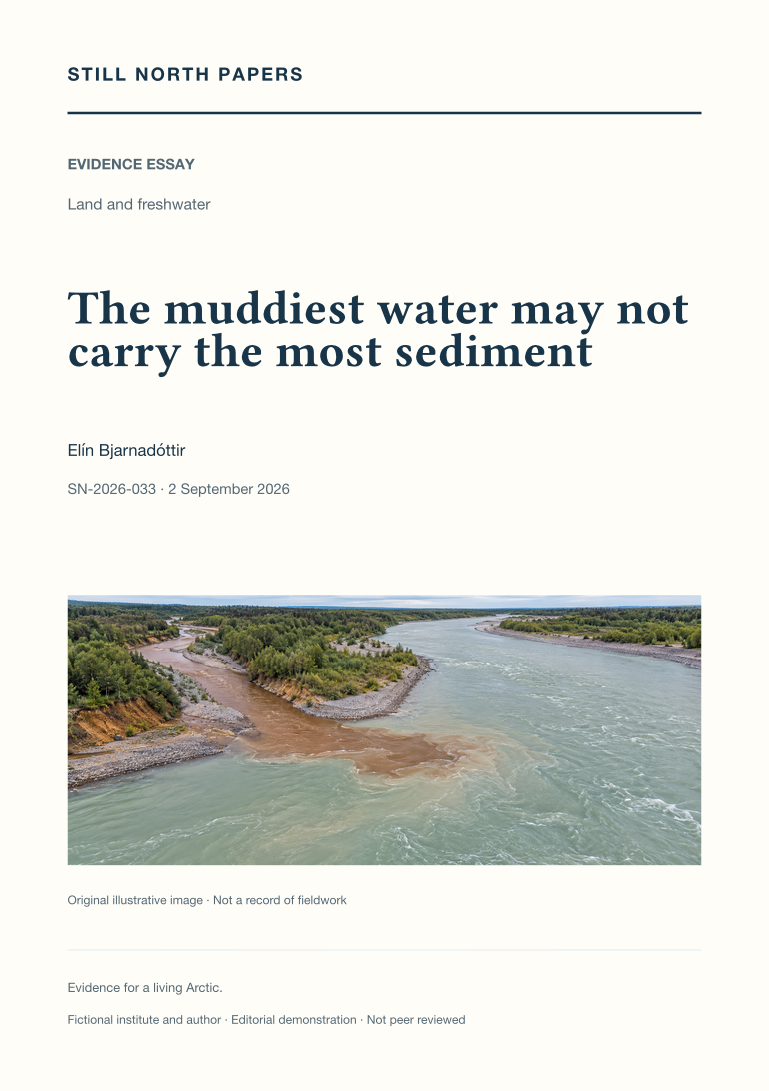
Not peer reviewed. Fictional demonstration publication. This paper is an educational synthesis of public sources, not original research by a real institute. Illustrative examples are not measured findings. The cover is a generated illustration. SN-2026-033 is a local archive identifier, not a DOI.
Abstract
Muddy appearance describes neither the full quantity of sediment transported nor its ecological consequences. This essay distinguishes suspended-sediment concentration, instantaneous mass flux, and load accumulated over time, using a hypothetical comparison in which the clearer stream transports more material. It examines event timing, changing sediment supply, and differences between rising and falling flows that can undermine a single concentration–discharge relationship. A published USGS river investigation supplies a methodological example, not an Arctic estimate. The discussion also explains why turbidity requires locally supported conversion relationships and why sampling position matters. Its practical recommendation is to retain discharge, sampling time, representative methods, and estimation periods with sediment results, while keeping transport separate from claims about contamination, drinking-water suitability, or ecological damage.
- Paper type
- Evidence essay
- Topic
- Land and freshwater
- Keywords
- suspended sediment; discharge; sediment load; turbidity; event sampling
- Format
- PDF, 2 pages; 731 words
Adaptation note
This paper adapts an existing Still North field-journal article. The original is retained unchanged. Read the source journal article; download its paper edition (PDF).
Sources and context
The PDF discusses these public sources and its limitations. A citation is not an endorsement of this demonstration archive.