By Priyanka Das, fictional Still North staff member. Published .
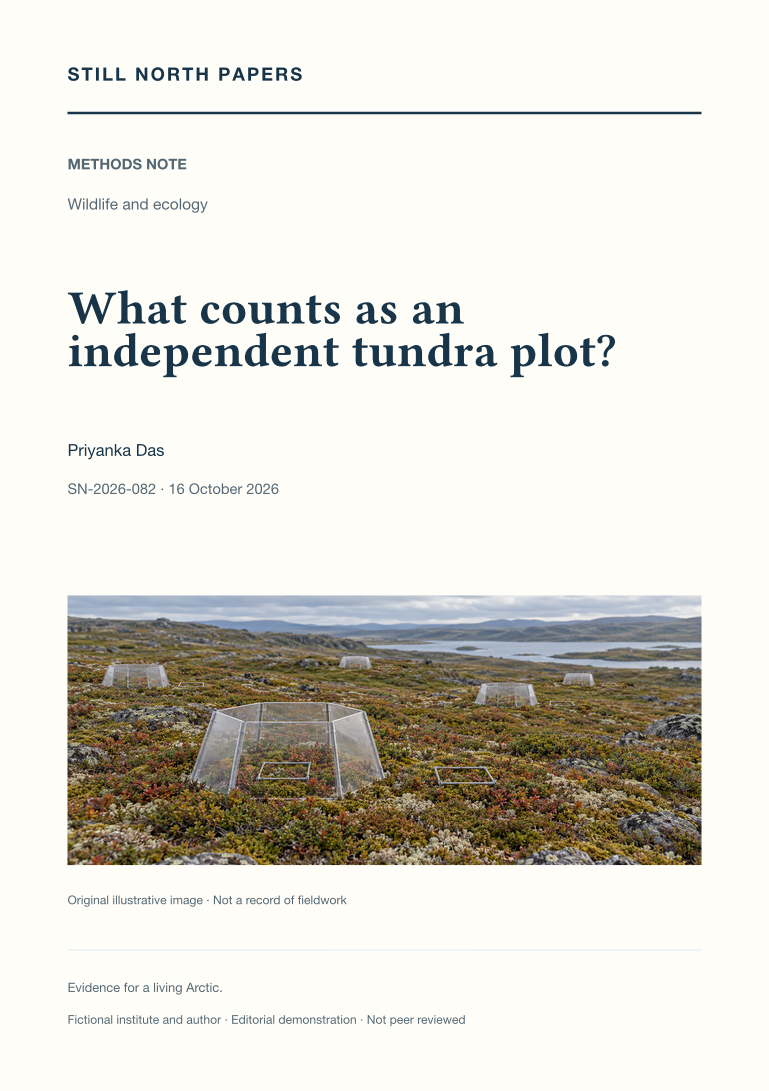
Not peer reviewed. Fictional demonstration publication. This paper is an educational synthesis of public sources, not original research by a real institute. Illustrative examples are not measured findings. The cover is a generated illustration. SN-2026-082 is a local archive identifier, not a DOI.
Abstract
Large numbers of tundra measurements need not provide large numbers of independent treatment tests. This methods note synthesises experimental-design principles, International Tundra Experiment guidance, and clustered spatial-sampling methods. It distinguishes measurement, quadrat, plot, block, and site, and separates spatial autocorrelation from the more fundamental problem of unreplicated treatment assignment. Fictional designs contrast intensive subsampling of one treated patch with replicated paired blocks, showing which level supports the treatment estimate. The discussion considers blocking, environmental side effects, hierarchical analysis, design-respecting resampling, regional generalisation, and the allocation of effort between breadth and detail. It offers no universal spacing or minimum replicate count. Its conclusion is a reporting practice that states sample sizes at each consequential level and matches every inferential claim to the independence the actual design supports.
- Paper type
- Methods note
- Topic
- Wildlife and ecology
- Keywords
- tundra plots; pseudoreplication; spatial autocorrelation; experimental units; blocked designs
- Format
- PDF, 3 pages; 1570 words
Sources and context
The PDF discusses these public sources and its limitations. A citation is not an endorsement of this demonstration archive.