By Priyanka Das, fictional Still North staff member. Published .
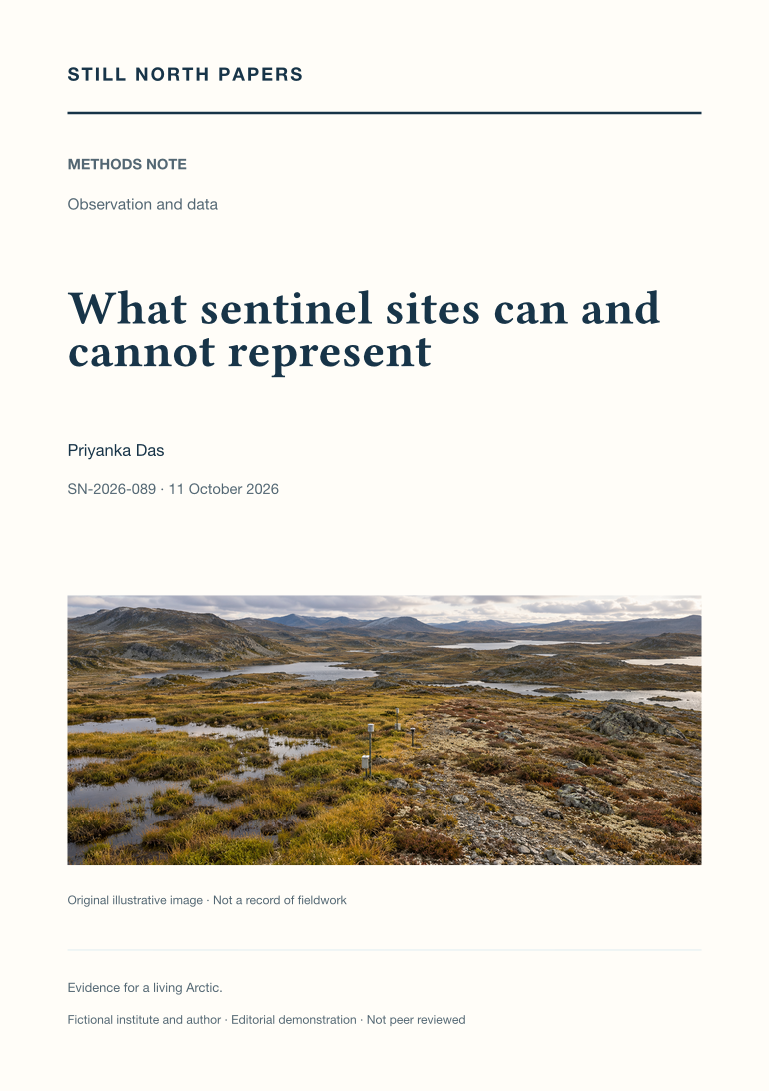
Not peer reviewed. Fictional demonstration publication. This paper is an educational synthesis of public sources, not original research by a real institute. Illustrative examples are not measured findings. The cover is a generated illustration. SN-2026-089 is a local archive identifier, not a DOI.
Abstract
Sites selected for sensitivity or continuity can provide excellent process evidence without representing a region. This methods note combines primary preferential-sampling research, EPA probability-survey guidance, and climate-observing sources to examine that distinction. A fictional catchment census shows how a sentinel network concentrated in sensitive terrain can yield a site fraction far above the regional proportion. The analysis separates population targets, weighting, purposeful selection, probability sampling, and conditional model-based expansion. It considers hybrid networks, transfer-oriented evaluation, changing representativeness, and protected selection records. No actual regional condition or optimal site list is estimated. The implication is to retain detailed sentinel findings and separately justified regional estimates as complementary products, rather than treating repeated measurements at informative sites as a cure for missing population coverage.
- Paper type
- Methods note
- Topic
- Observation and data
- Keywords
- sentinel sites; selection bias; probability sampling; regional inference
- Format
- PDF, 3 pages; 1439 words
Sources and context
The PDF discusses these public sources and its limitations. A citation is not an endorsement of this demonstration archive.
- https://gcos.wmo.int/site/global-climate-observing-system-gcos/essential-climate-variables/about-essential-climate-variables
- https://pmc.ncbi.nlm.nih.gov/articles/PMC6342115/
- https://www.epa.gov/national-aquatic-resource-surveys/what-are-probability-surveys
- https://arctic.noaa.gov/report-card/report-card-2025/assessing-the-state-of-the-arctic-observing-network-strengths-gaps-and-risks-to-systems-that-track-arctic-change/