By Priyanka Das, fictional Still North staff member. Published .
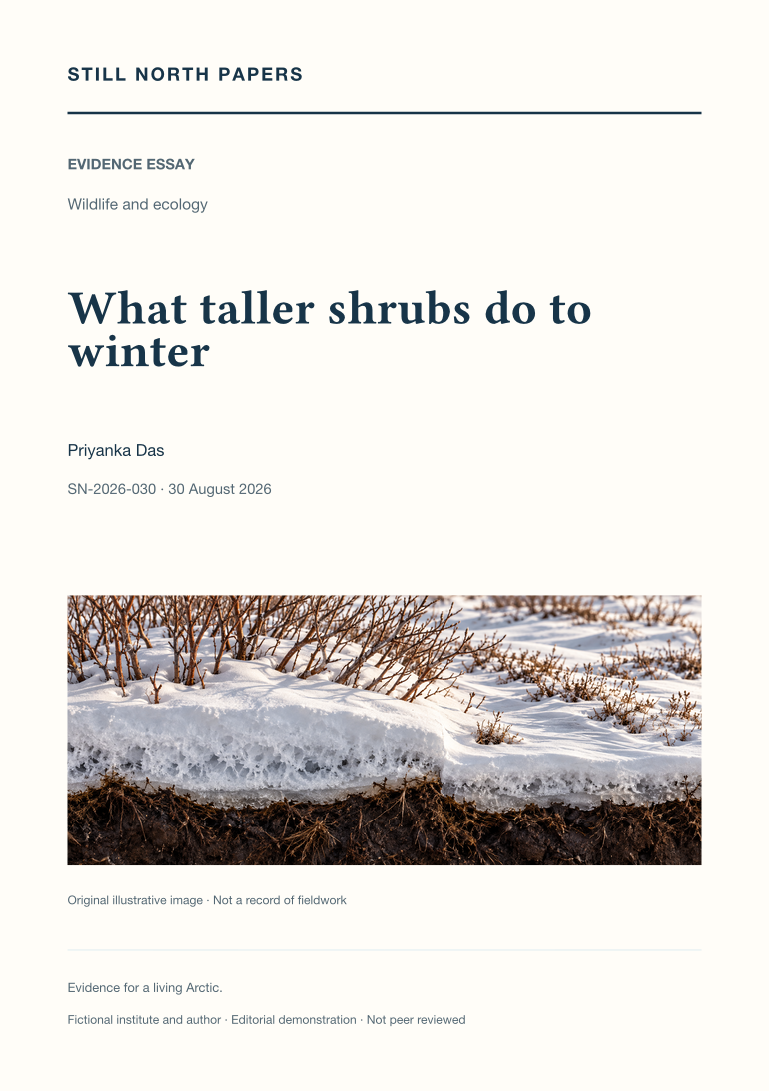
Not peer reviewed. Fictional demonstration publication. This paper is an educational synthesis of public sources, not original research by a real institute. Illustrative examples are not measured findings. The cover is a generated illustration. SN-2026-030 is a local archive identifier, not a DOI.
Abstract
Taller tundra shrubs are followed through winter snow, spring radiation, and summer soil conditions rather than assigned one warming or cooling effect. Published Bylot Island observations show how shrub-associated snow depth, density, conductivity, and melt can change insulation in competing ways. Their winter simulations remain explicitly seasonal, not annual forecasts for Arctic permafrost. A separate Siberian vegetation comparison illustrates why lower surface albedo can coexist with a shallower active layer when soil and moisture conditions differ, without proving the effect of replacing one vegetation type with another. The essay proposes matched observations of vegetation, snow structure, soil temperature, moisture, and thaw across comparable terrain. Its implication is to retain the cold season and ground properties when interpreting a visible change in summer vegetation.
- Paper type
- Evidence essay
- Topic
- Wildlife and ecology
- Keywords
- tundra shrubs; snow insulation; soil temperature; seasonal effects; active-layer thickness
- Format
- PDF, 2 pages; 715 words
Adaptation note
This paper adapts an existing Still North field-journal article. The original is retained unchanged. Read the source journal article; download its paper edition (PDF).
Sources and context
The PDF discusses these public sources and its limitations. A citation is not an endorsement of this demonstration archive.