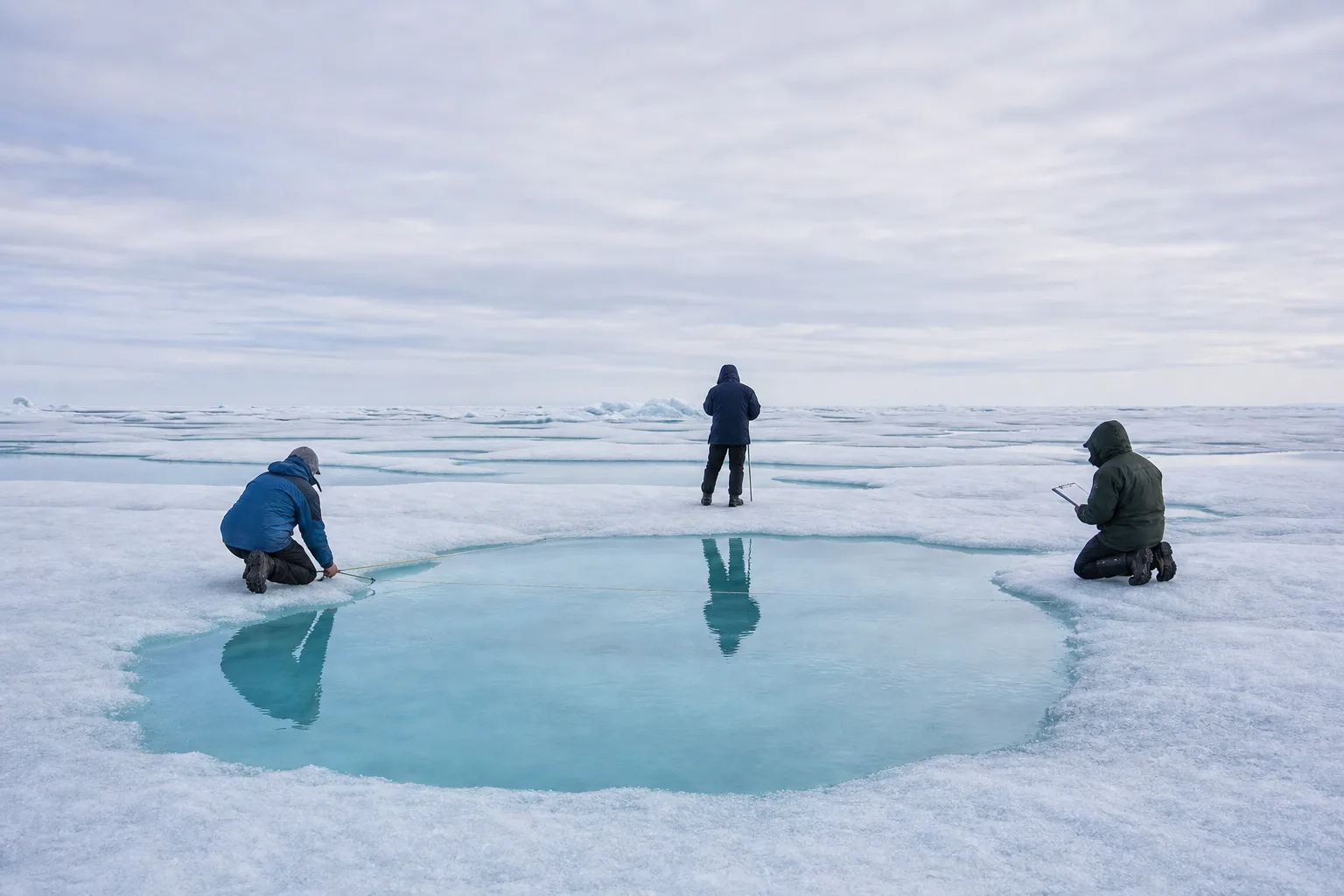
This is an illustrative field note, not a record of a Still North expedition. It shows how local observations at an ice edge can connect to a regional record. One day, one floe, or one photograph cannot support a conclusion about the whole Arctic.
The scene begins with a broad margin between compact ice and open water north of Svalbard. Wind moves low cloud across a surface broken by dark leads. Melt ponds hold different shades depending on depth, sediment, bubbles, and the angle of light. Each detail is observable. None yet says how typical the place is.
Ridges and younger cover
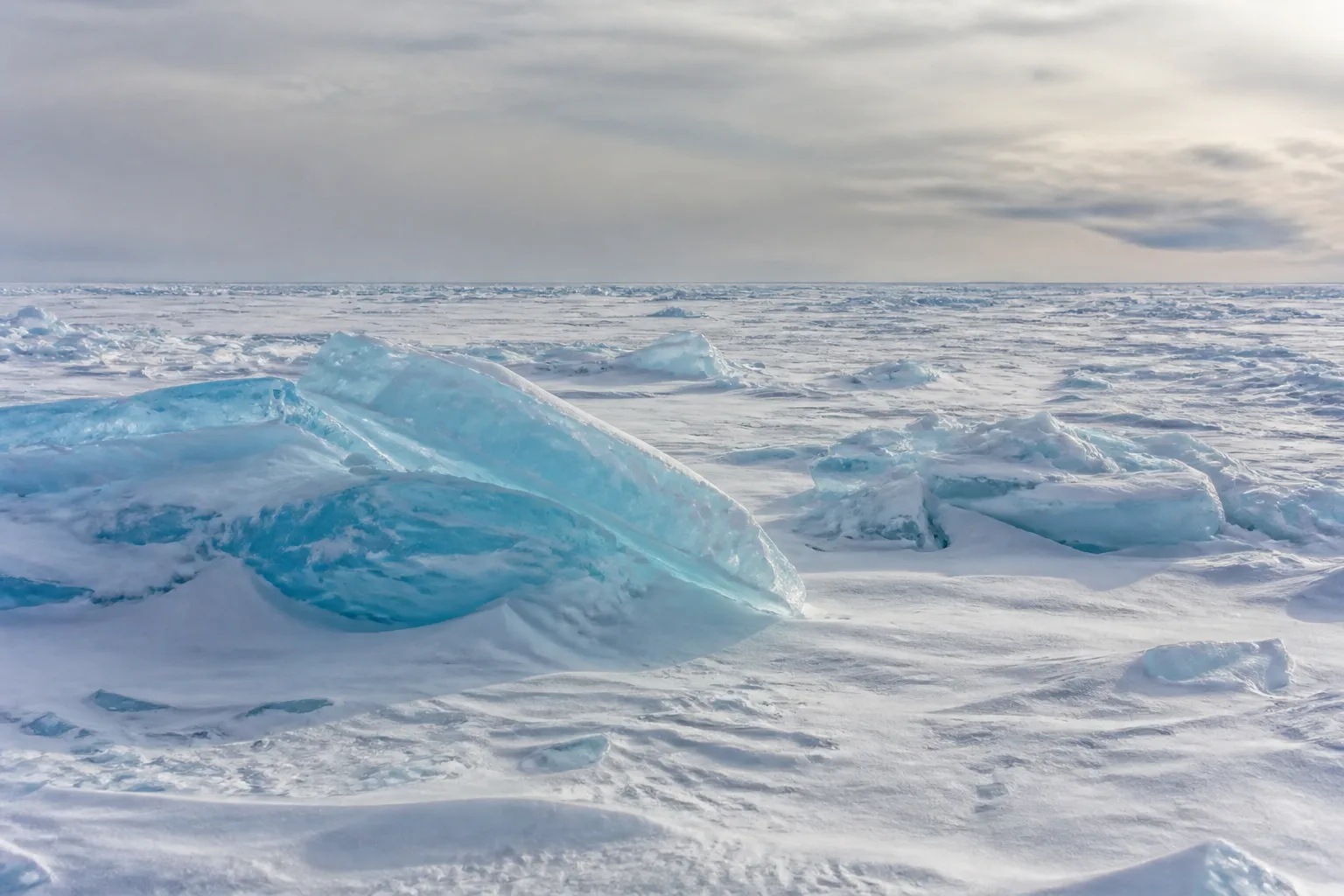
Pressure ridges form where moving floes converge and ice is pushed above and below the level surface. A ridge can be much thicker than nearby undeformed ice. Measuring only the ridge would bias an estimate high, while avoiding every difficult surface would bias a route toward smooth ice. A sampling plan needs both the feature and the surrounding context.
The NOAA Arctic Report Card 2025 sea-ice chapter reports that ice older than four years has declined by more than 95% since the 1980s. Younger ice now dominates the cover. That shift matters because age, salinity, snow, thickness, and prior deformation shape how ice responds to wind, waves, and summer energy. It does not make every young floe identical.
A field measurement becomes regional evidence only through a clear account of scale, selection, and comparison.
Melt ponds are not one signal
A pond absorbs more sunlight than a bright snow surface, but pond fraction changes through the melt season. Drainage, cracks, snowfall, cloud, and ice topography all matter. A team might photograph fixed points, measure transects, and record date and weather, then compare those observations with a satellite product that resolves a much larger area. The comparison should preserve the difference in scale.
Three views, each with limits
Distance belongs in the method
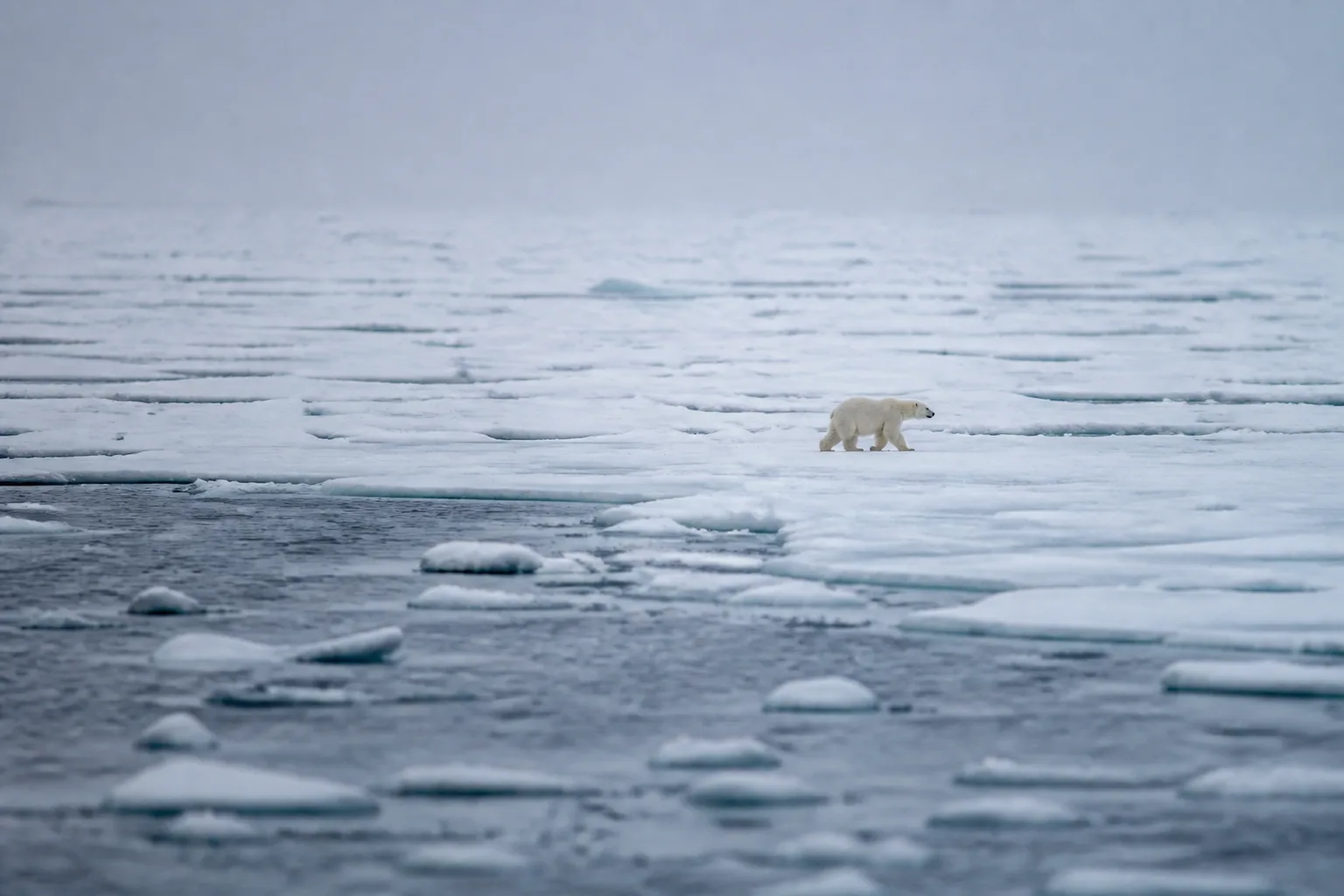
A polar bear is seen far along the edge. The useful response is not to close the distance for a stronger image. Wildlife protocols, local guidance, visibility, vessel or camp position, and an agreed stop point determine what happens next. A long lens can document the animal as a small part of the landscape and avoid implying a close encounter that never occurred.
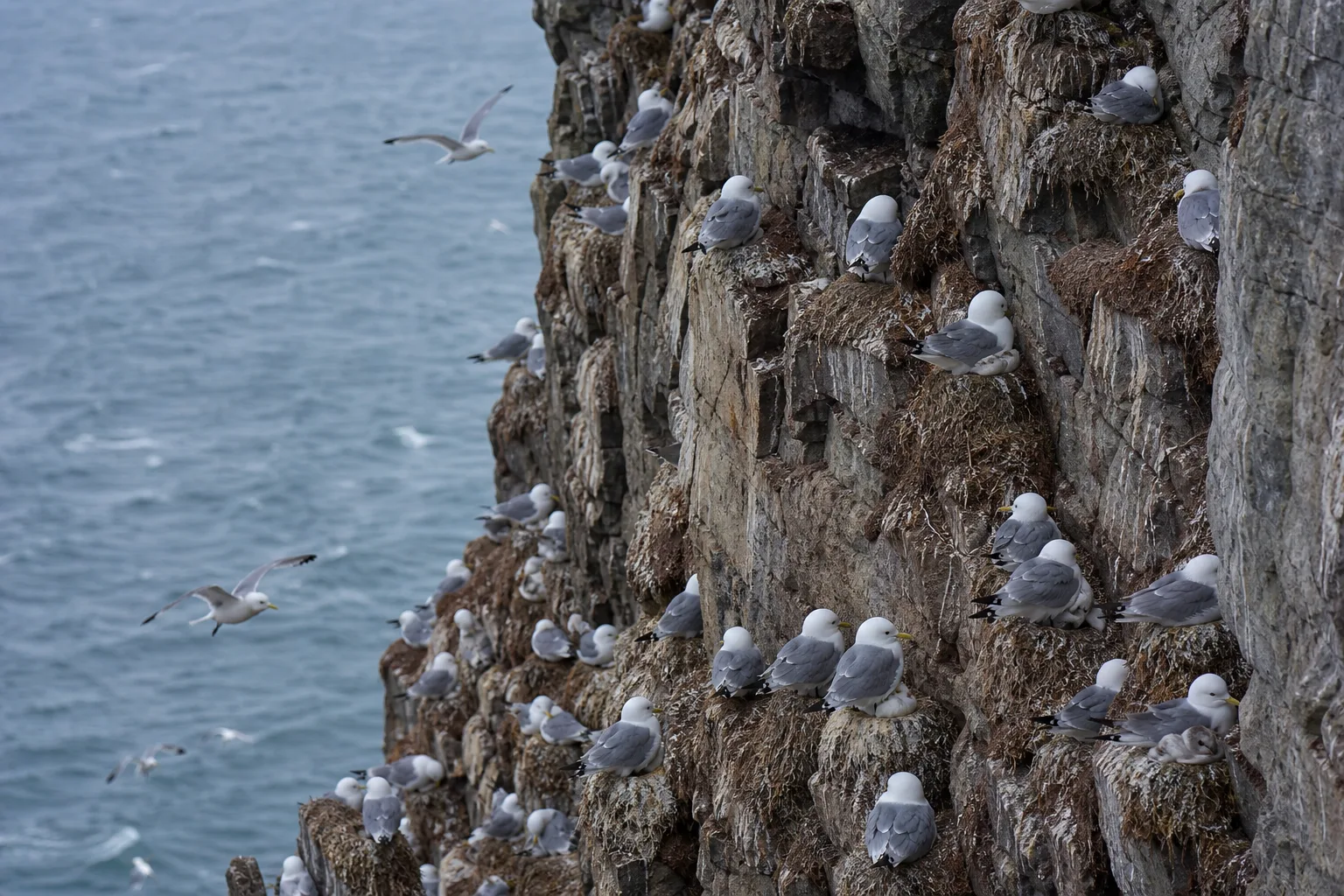
Kittiwakes crossing between water and cliff offer another observation. Their presence can suggest feeding and breeding activity, but a short watch cannot establish colony success or prey change. Time of day, season, weather, and observation effort travel with the note. Ordinary absences should be recorded too.
What the younger ice changes
Younger cover changes the starting condition for each season. It can be more responsive to forcing, while ridges and snow maintain strong local variation. The March 2025 maximum was the lowest in the satellite record, and the September daily minimum was 4.60 million km², tenth lowest in that record. Those NOAA results frame the field scene. They were not produced by it.
The responsible conclusion is narrower and more useful: this illustrative day contains processes that long records also track, including deformation, ponding, habitat use, and a cover dominated by younger ice. The next question is what comparable observations, at what scales and times, can test how those processes are changing.
Before the route closes
The final check is not a hunt for one more observation. Weather, visibility, drift, return distance, communications, and agreed limits determine departure. A field plan that requires people to stay for a complete sequence has confused scientific neatness with safe practice. Missing data can be documented. A delayed return can create risks that no measurement justifies.
Back on a stable platform, photographs are matched with times and positions, instrument files are copied, and notes identify anomalies. The gallery keeps three different forms of evidence separate: ice structure, a distant animal, and a seabird colony. Their proximity on a page does not prove a causal relationship. It invites questions that require other records.
A clear handover records which questions remain open for the next comparable visit.

Leave a Reply