By Theo Nguyen, fictional Still North staff member. Published .
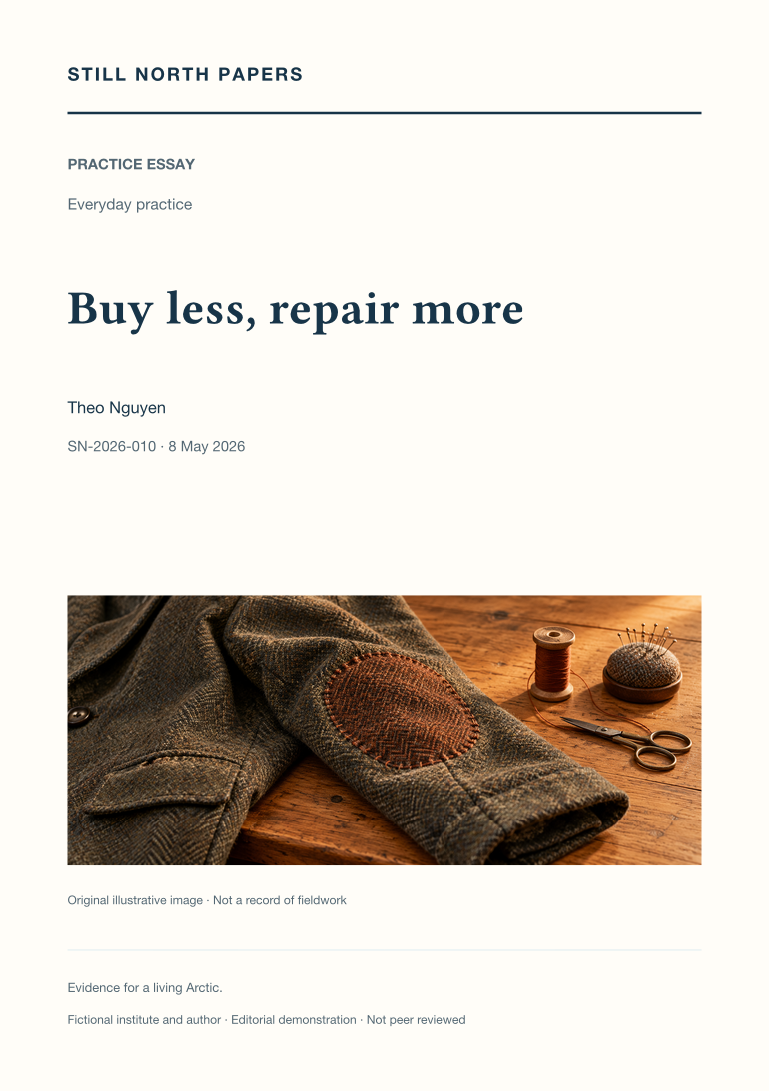
Not peer reviewed. Fictional demonstration publication. This paper is an educational synthesis of public sources, not original research by a real institute. Illustrative examples are not measured findings. The cover is a generated illustration. SN-2026-010 is a local archive identifier, not a DOI.
Abstract
Keeping a product useful begins with identifying the function required, not assuming that every fault demands a purchase. This practice essay compares care, repair, borrowing, sharing, and justified replacement through a checklist covering safety, warranty, recalls, parts, skills, time, and likely continued service. Textile mending offers a lower-risk example, while electrical, structural, and other safety-critical work retains a clear boundary for trained help. The discussion examines rebound consumption, inaccessible product design, procurement, and the institutional conditions that permit repair at scale, using the cited IPCC demand-side assessment as context. Responsible end-of-life handling includes personal data, hazardous components, and whether a donated item is genuinely usable and wanted. No repair is presented as automatically safe, economical, or environmentally preferable in every case.
- Paper type
- Practice essay
- Topic
- Everyday practice
- Keywords
- repair decisions; product longevity; maintenance; right to repair; rebound consumption
- Format
- PDF, 2 pages; 706 words
Adaptation note
This paper adapts an existing Still North field-journal article. The original is retained unchanged. Read the source journal article; download its paper edition (PDF).
Sources and context
The PDF discusses these public sources and its limitations. A citation is not an endorsement of this demonstration archive.