By Amina Okafor, fictional Still North staff member. Published .
Not peer reviewed. Fictional demonstration publication. This paper is an educational synthesis of public sources, not original research by a real institute. Illustrative examples are not measured findings. The cover is a generated illustration. SN-2026-068 is a local archive identifier, not a DOI.
Abstract
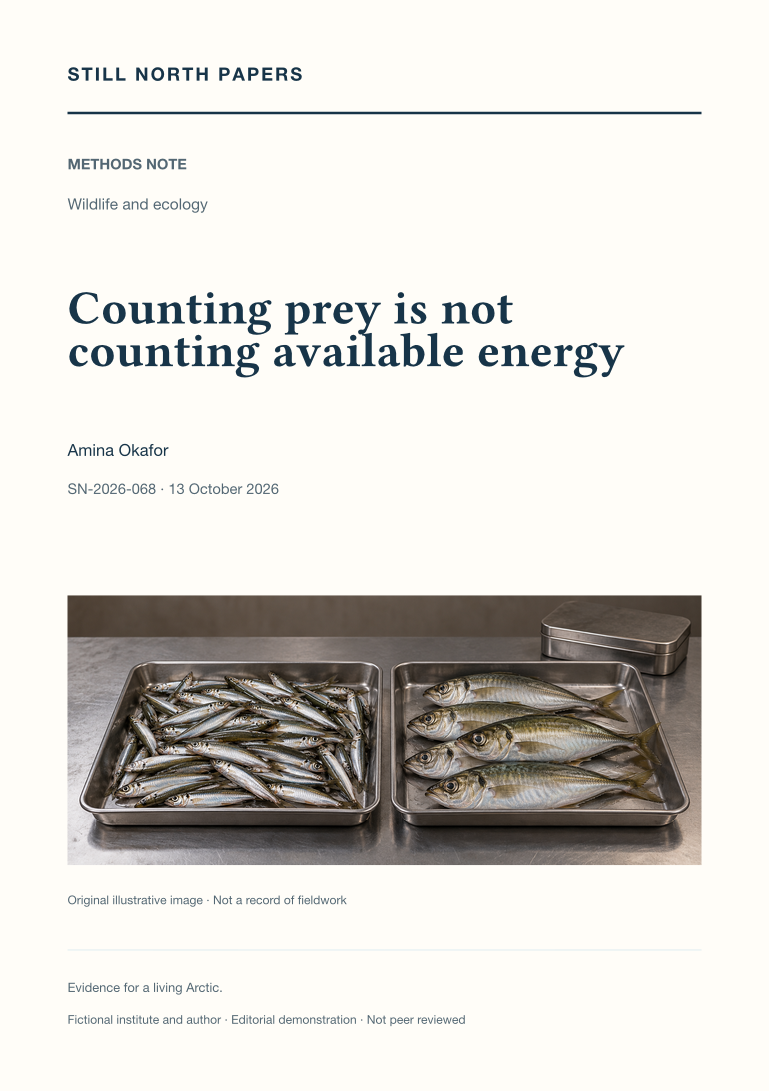
Prey counts, biomass, potential energy, and predator benefit need not change in the same direction. This methods note combines forage-fish composition measurements, comparative cetacean evidence, and an ontogenetic consumption analysis to clarify the conversion among those quantities. Invented samples demonstrate a forty-percent decline in count alongside an eighty-percent increase in calculated energy, while additional examples expose wet-versus-dry-mass errors and conditional assimilation assumptions. The cited studies span subarctic and other marine systems; their fitted values are not treated as Arctic constants. The note does not estimate actual ingestion or predator fitness. It argues for retaining counts and biomass alongside energetic conversions, then asking whether a specified consumer can capture the relevant prey, at an appropriate season and life stage, for a useful net return.
- Paper type
- Methods note
- Topic
- Wildlife and ecology
- Keywords
- prey energy; food webs; forage fish; energy density; wet mass
- Format
- PDF, 2 pages; 1393 words
Sources and context
The PDF discusses these public sources and its limitations. A citation is not an endorsement of this demonstration archive.