By Noor Rahman, fictional Still North staff member. Published .
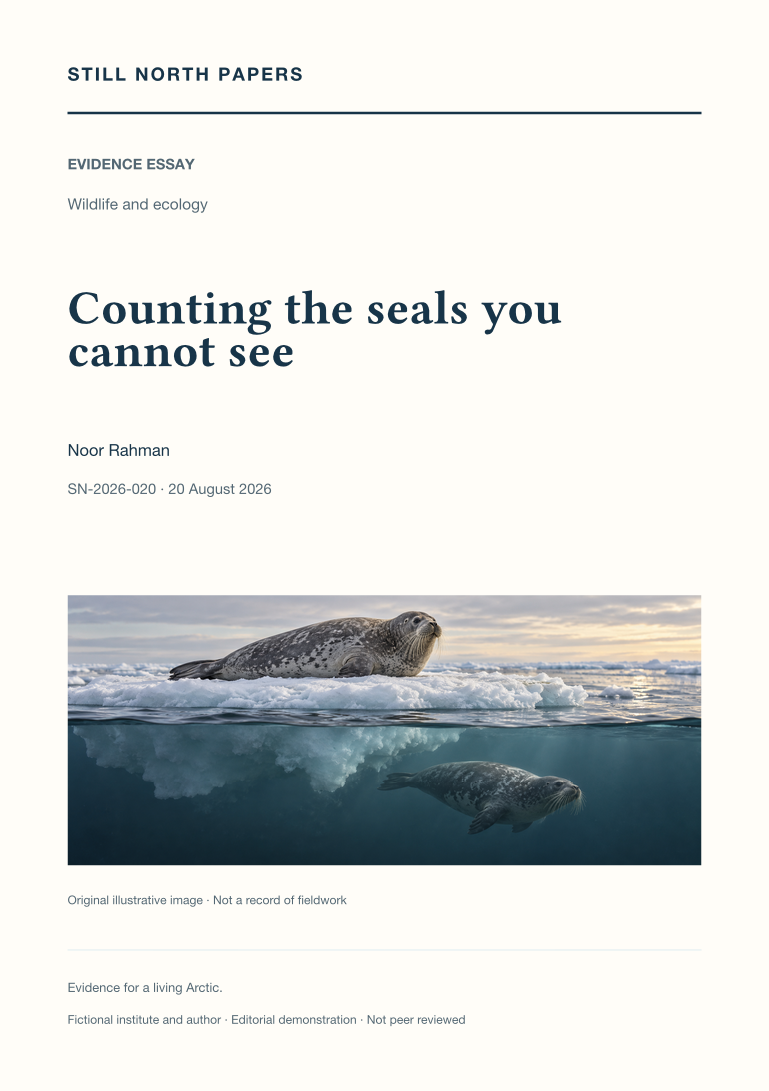
Not peer reviewed. Fictional demonstration publication. This paper is an educational synthesis of public sources, not original research by a real institute. Illustrative examples are not measured findings. The cover is a generated illustration. SN-2026-020 is a local archive identifier, not a DOI.
Abstract
Aerial seal counts are interpreted by separating availability to a survey from recognition of an animal that is available. The essay discusses published biologger research on bearded, ribbon, and spotted seals, showing why haul-out timing, weather, season, and demographic group affect the visible fraction. A deliberately invented calculation demonstrates that the same count can imply different totals under different availability assumptions, without proposing correction factors for real surveys. Ringed seals require additional treatment because snow lairs can conceal animals that are already out of the water. The discussion also considers tagging selection, device lifetime, temporal dependence, coverage, and identification error. Better population inference needs representative evidence and propagated uncertainty, while personal observations should retain effort and conditions without approaching wildlife to complete a count.
- Paper type
- Evidence essay
- Topic
- Wildlife and ecology
- Keywords
- ice seals; haul-out behaviour; availability bias; aerial surveys; abundance uncertainty
- Format
- PDF, 2 pages; 722 words
Adaptation note
This paper adapts an existing Still North field-journal article. The original is retained unchanged. Read the source journal article; download its paper edition (PDF).
Sources and context
The PDF discusses these public sources and its limitations. A citation is not an endorsement of this demonstration archive.