By Amina Okafor, fictional Still North staff member. Published .
Not peer reviewed. Fictional demonstration publication. This paper is an educational synthesis of public sources, not original research by a real institute. Illustrative examples are not measured findings. The cover is a generated illustration. SN-2026-036 is a local archive identifier, not a DOI.
Abstract
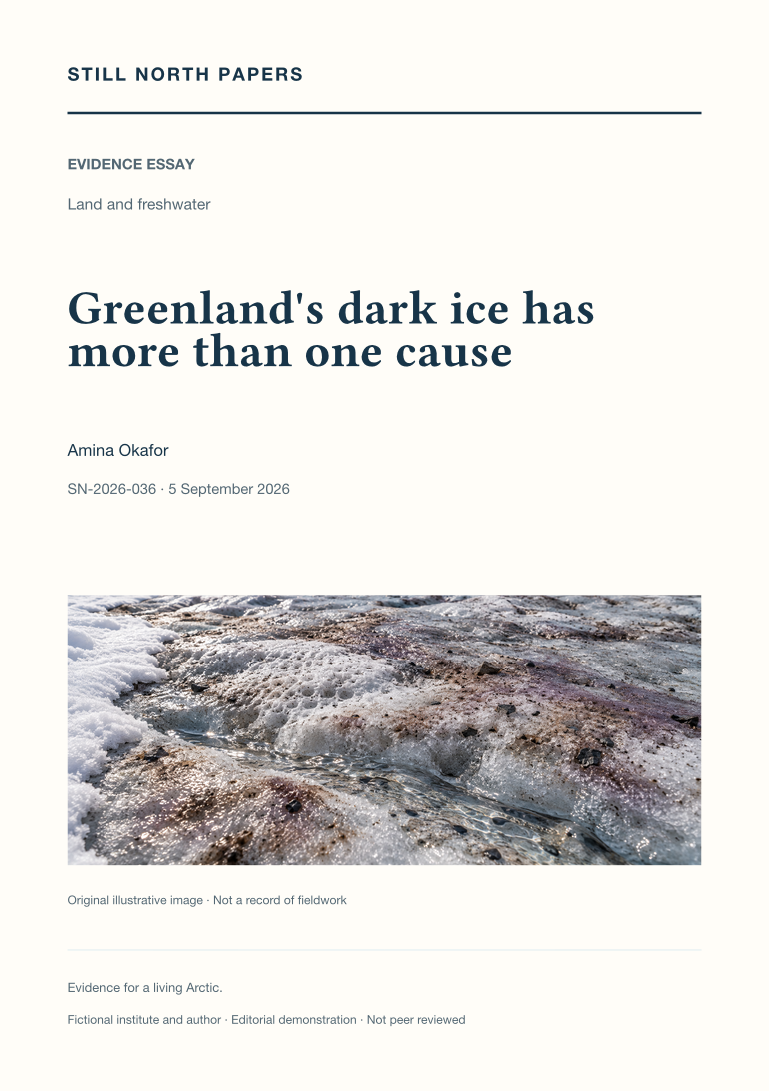
Dark Greenland ice can reflect snow retreat, light-absorbing material, glacier algae, water, and changing surface texture. This essay separates observed colour, attribution of reflectivity changes, and consequences for melt. NOAA's Greenland assessment provides seasonal context, while a western Greenland study illustrates how biological sampling, radiation measurements, and aerial observations constrain the contribution of algae alongside the physical weathering crust. Neither source makes every dark patch biologically equivalent. The discussion explains why a satellite pixel can miss small algal patches and why a selected ground measurement may not represent the wider footprint. Its central implication is methodological: compatible scales, timing, and illumination are needed before linking surface appearance to mechanisms or melt, and local findings cannot be expanded into an ice-sheet-wide total without further evidence.
- Paper type
- Evidence essay
- Topic
- Land and freshwater
- Keywords
- Greenland; albedo; glacier algae; surface energy balance; spatial sampling
- Format
- PDF, 2 pages; 727 words
Adaptation note
This paper adapts an existing Still North field-journal article. The original is retained unchanged. Read the source journal article; download its paper edition (PDF).
Sources and context
The PDF discusses these public sources and its limitations. A citation is not an endorsement of this demonstration archive.