By Amina Okafor, fictional Still North staff member. Published .
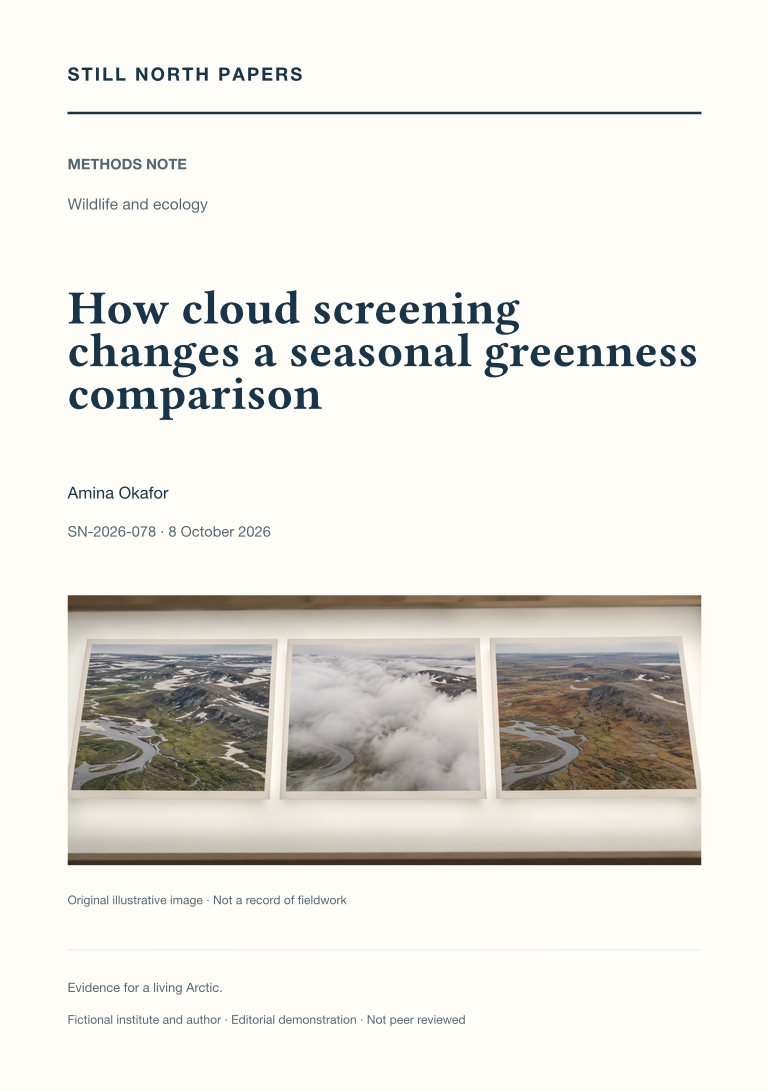
Not peer reviewed. Fictional demonstration publication. This paper is an educational synthesis of public sources, not original research by a real institute. Illustrative examples are not measured findings. The cover is a generated illustration. SN-2026-078 is a local archive identifier, not a DOI.
Abstract
Seasonal vegetation composites summarise retained observations, not an equally observed season. This methods note synthesises MODIS compositing guidance, Landsat quality-band documentation, and NOAA tundra-greenness methods to examine the interaction between cloud screening and ecological comparison. A fictional pixel history shows how an unseen peak can lower both observed maximum and available-observation mean without any underlying vegetation change. The analysis distinguishes seasonal statistics, selected observation dates, quality thresholds, reconstruction, changing spatial footprints, and cross-sensor support. It proposes coverage diagnostics and sensitivity comparisons that remain tied to the chosen question. No imagery is reprocessed and no published Arctic trend is re-estimated. The conclusion is that greenness results become more interpretable when observation timing, masks, and fitted values accompany the statistic rather than disappearing inside a seamless map.
- Paper type
- Methods note
- Topic
- Wildlife and ecology
- Keywords
- seasonal greenness; cloud masking; NDVI composites; observation timing; tundra remote sensing
- Format
- PDF, 3 pages; 1451 words
Sources and context
The PDF discusses these public sources and its limitations. A citation is not an endorsement of this demonstration archive.