By Elín Bjarnadóttir, fictional Still North staff member. Published .
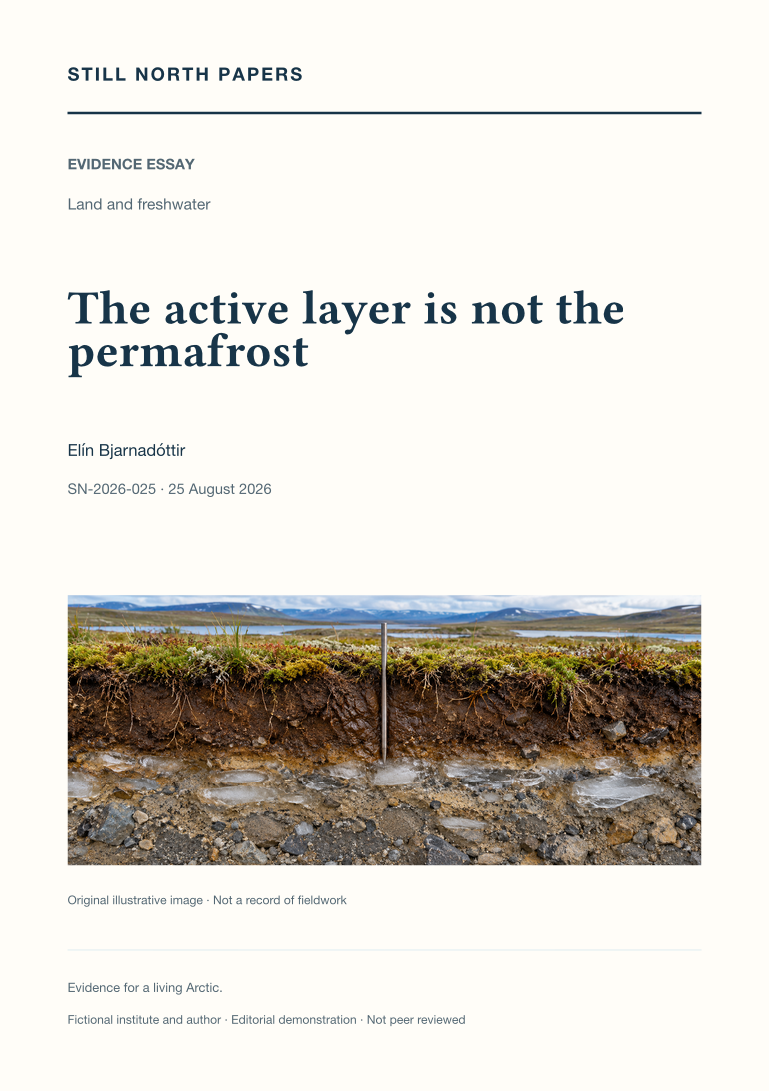
Not peer reviewed. Fictional demonstration publication. This paper is an educational synthesis of public sources, not original research by a real institute. Illustrative examples are not measured findings. The cover is a generated illustration. SN-2026-025 is a local archive identifier, not a DOI.
Abstract
The active layer and permafrost are distinguished by their different seasonal and thermal definitions. This essay explains why thaw depth on one visit is not necessarily annual maximum active-layer thickness, and why neither measurement alone establishes the condition of deeper ground. Hypothetical sites with matching thaw depths but different temperature and ground-ice properties illustrate the limit. NSIDC definitions, the Circumpolar Active Layer Monitoring protocol, and NOAA's carbon assessment support a comparison of probing, frost tubes, and temperature records. Snow, vegetation, moisture, disturbance, and latent heat complicate simple links between air temperature and ground response. The practical reading method asks whether a claim concerns a thaw boundary, warming, ice loss, or permafrost disappearance before matching its depth, date, coverage, and method to a decision.
- Paper type
- Evidence essay
- Topic
- Land and freshwater
- Keywords
- active layer; permafrost; ground temperature; ground ice; thaw monitoring
- Format
- PDF, 2 pages; 697 words
Adaptation note
This paper adapts an existing Still North field-journal article. The original is retained unchanged. Read the source journal article; download its paper edition (PDF).
Sources and context
The PDF discusses these public sources and its limitations. A citation is not an endorsement of this demonstration archive.