By Amina Okafor, fictional Still North staff member. Published .
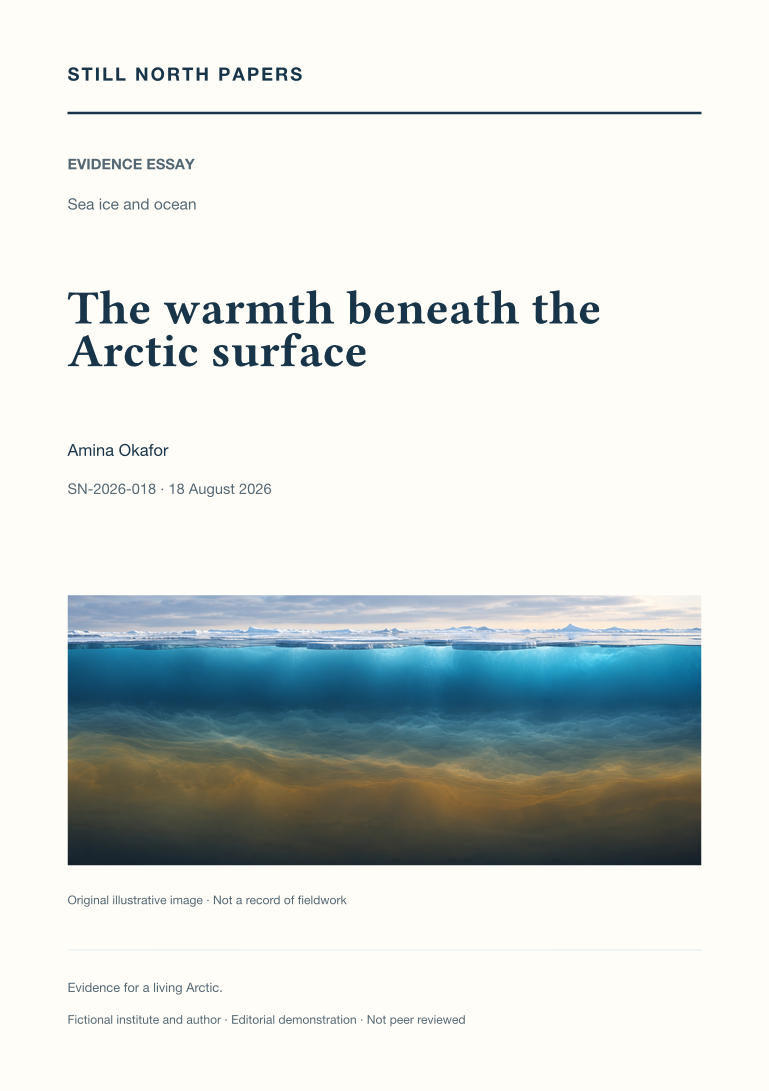
Not peer reviewed. Fictional demonstration publication. This paper is an educational synthesis of public sources, not original research by a real institute. Illustrative examples are not measured findings. The cover is a generated illustration. SN-2026-018 is a local archive identifier, not a DOI.
Abstract
Subsurface Arctic warmth is examined through the density structure that separates a heat reservoir from the ice above it. The essay explains how salinity can keep warmer Atlantic-origin water beneath a colder, fresher surface layer and uses contrasting hypothetical columns to distinguish stored energy from access to that energy. Heat content, horizontal transport, and upward flux are treated as separate quantities requiring different observations. Published Atlantification evidence supplies regional contrasts rather than a claim that the entire Arctic has lost its stratification. The discussion connects upward heat transfer with reduced winter ice growth and potentially changed nutrient supply, without prescribing one ecological outcome. Temperature, salinity, velocity, mixing, depth, and position are therefore needed to follow the mechanism from incoming water to a measured effect at the surface.
- Paper type
- Evidence essay
- Topic
- Sea ice and ocean
- Keywords
- Atlantification; halocline; ocean heat transport; upward heat flux; stratification
- Format
- PDF, 2 pages; 730 words
Adaptation note
This paper adapts an existing Still North field-journal article. The original is retained unchanged. Read the source journal article; download its paper edition (PDF).
Sources and context
The PDF discusses these public sources and its limitations. A citation is not an endorsement of this demonstration archive.